

Among the many challenges facing livestock production in South East Asia, reduced feed intake during periods of high ambient temperature is probably the one with the greatest economic impact. Whether in lactating sows, growing pigs, broilers or laying hens, animals naturally reduce voluntary feed intake as temperatures rise. This physiological adaptation limits internal heat production but also reduces growth, milk production, egg production and profitability.
Most adult pigs perform best between 16 and 22°C, while broilers older than three weeks and laying hens are most comfortable between 18 and 24°C. Above these temperatures, voluntary feed intake progressively declines. Every kilogram of feed generates heat during digestion and metabolism. Eating less is therefore the animal’s most effective way to reduce body heat. At the same time, more blood is redirected towards the skin to dissipate heat, leaving less circulation available for the digestive tract and reducing nutrient utilization.
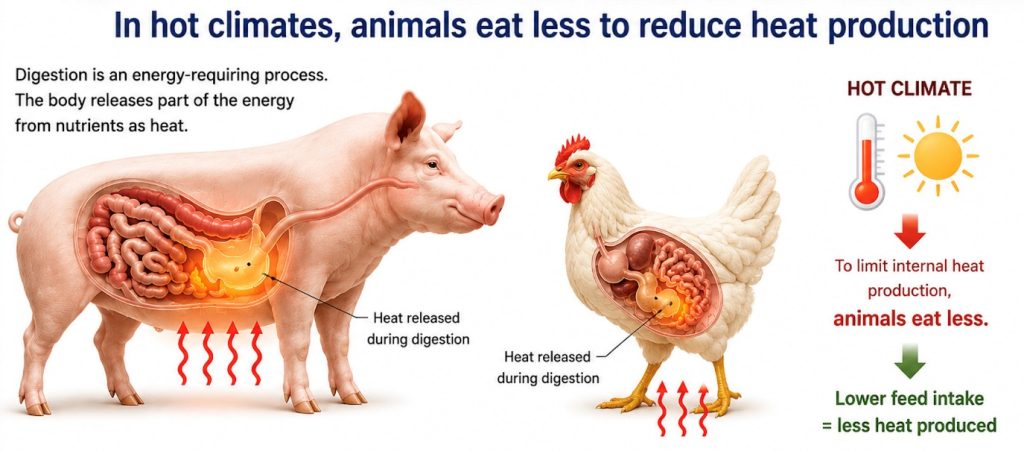
The consequences are observed across all species. Lactating sows consume 1 to 2 kg less feed per day, reducing milk production and increasing body reserve mobilisation. Broilers grow more slowly because both energy and amino acid intake decline. Growing pigs require more days to reach market weight, while laying hens produce fewer eggs with lower egg mass. Improving feed intake should therefore become one of the main objectives of nutritionists working in tropical climates.
The first priority is water. Feed intake and water intake are closely linked, and even a slight reduction in water consumption rapidly depresses appetite. Water should always be clean, cool (under the shade) and freely available. Adequate flow rate is equally important: 2-4 L/min for lactating sows, 1-2 L/min for growing pigs, 0.5-1 L/min for nursery pigs, 60-80 mL/min for broilers and 80-100 mL/min for laying hens. Water pressure should be adjusted to achieve these flow rates while avoiding excessive leakage, and water lines should be cleaned regularly to preserve microbiological quality.
Drinking more water, however, is only half of the solution. Water must also remain inside the body’s cells. High ambient temperatures increase water losses through respiration and evaporation, leading to cellular dehydration and reduced enzyme activity.
Modern feed formulation can further increase this challenge. Diets formulated with high levels of crystalline amino acids, organic acids and soluble mineral salts become more osmotic. Water is attracted towards the intestinal lumen, increasing the risk of enterocyte dehydration and reducing nutrient absorption. As low-protein diets become increasingly popular, maintaining cellular hydration also becomes increasingly important.
Trimethylglycine (betaine) is one of nature’s most effective cellular osmolytes. It accumulates inside cells without disturbing metabolism, helping retain intracellular water while reducing the energy required for osmoregulation. Besides helping animals cope with high ambient temperatures, trimethylglycine complements modern low-protein formulations by protecting enterocytes against osmotic imbalance, thereby supporting nutrient absorption and feed intake.
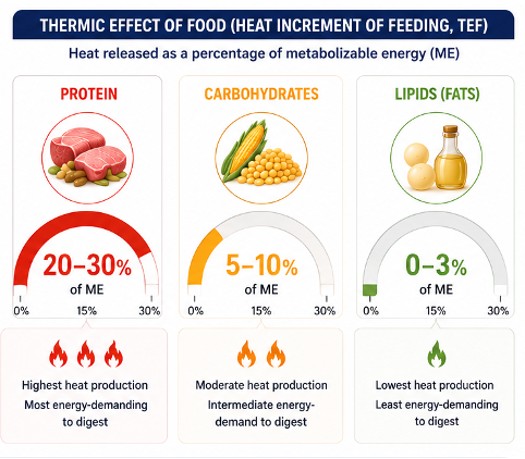
Nutritionists should also minimise the amount of heat generated during nutrient utilisation. Optimising diets on a Net Energy (NE) basis rather than Metabolisable Energy (ME) is one of the most effective strategies because NE accounts for the heat produced during digestion and metabolism, providing a more accurate estimate of the energy available for growth, milk or egg production.
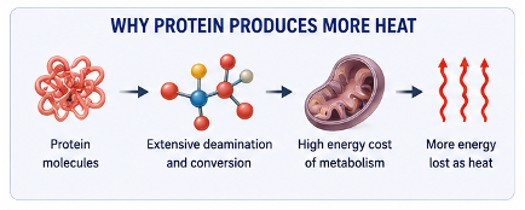
An additional advantage of NE formulation is that it naturally encourages better ingredient selection. When no minimum crude protein constraint is imposed, least-cost formulation generally reduces excess protein while increasing dietary fat. This is desirable because protein has the highest heat increment. Excess amino acids must be converted into urea in pigs or uric acid in poultry, processes that generate considerable metabolic heat. Fat, on the other hand, is utilised more efficiently and produces substantially less heat than either protein or carbohydrates.
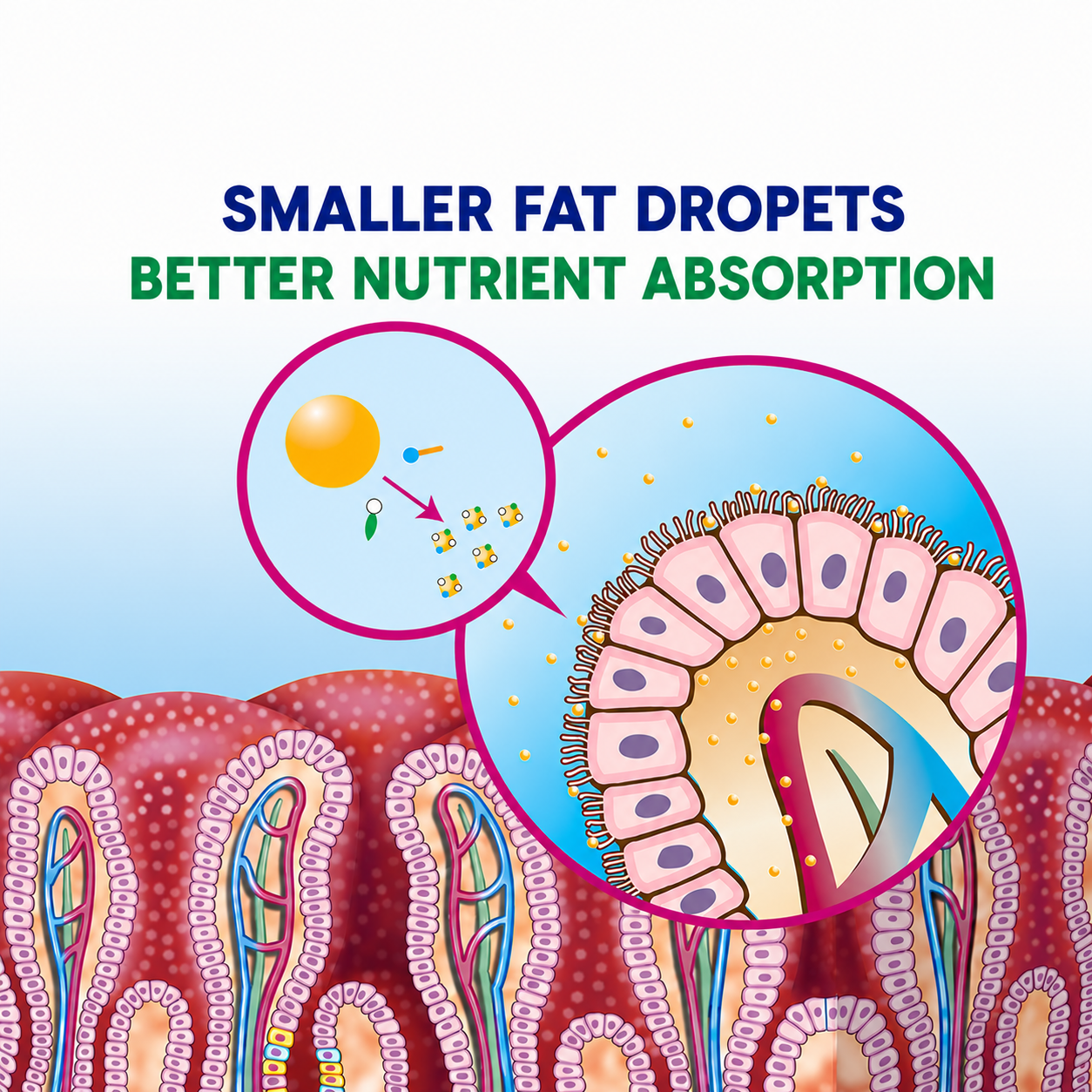
As feed intake declines, every kilogram of feed must therefore provide more usable energy. Increasing dietary fat becomes an excellent strategy, provided that fat digestion is optimised. Modern emulsifiers, particularly lysophospholipids, improve fat emulsification, micelle formation and lipid absorption, allowing animals to extract more Net Energy from every kilogram of feed consumed.
Finally, nutritionists should pay close attention to the type of fibre included in the diet. Fermentation in the large intestine generates heat, further increasing the animal’s thermal load and contributing to lower feed intake. Rather than simply reducing total fibre, nutritionists should limit highly fermentable fibres while maintaining adequate levels of non-fermentable insoluble fibres. Purified lignocellulose stimulates intestinal motility and maintains regular transit with minimal fermentation, preserving digestive function without generating unnecessary heat.
High ambient temperatures cannot be controlled on every farm, but their impact on feed intake can be greatly reduced. Clean water supplied at the correct flow rate, improved cellular hydration through trimethylglycine, Net Energy formulation, lower crude protein, balanced Dietary Electrolyte Balance, efficient fat utilisation with emulsifiers and adequate insoluble fibre all contribute to the same objective: helping animals consume more feed while generating less internal heat. In tropical livestock production, improving feed intake is not simply another nutritional strategy—it is the foundation of productivity.
David Serene