

In animal nutrition, most antibacterial feed additives act directly against pathogens through chemical or biological mechanisms. Chitosan is different. Its remarkable properties originate from a unique characteristic: it is one of the few naturally occurring polysaccharides capable of carrying multiple positive electrical charges along its molecular structure. This characteristic allows chitosan to interact with bacterial membranes and enhance the antibacterial activity of other compounds, particularly organic acids.
Understanding why chitosan is positively charged, and why its polymeric structure matters, helps explain how relatively small quantities can improve antibacterial efficiency.
What makes chitosan unique?
Chitosan is obtained by deacetylating chitin, a natural structural polysaccharide found in crustacean shells, insects and fungi.
Unlike cellulose, starch and most other natural polysaccharides, chitosan contains numerous free amino groups (–NH₂). Under acidic conditions, these groups become protonated (–NH₃⁺), giving the molecule multiple positive electrical charges.
This is particularly important because bacterial surfaces are generally negatively charged due to phospholipids, proteins and other structural components.
Opposite electrical charges attract each other. Consequently, positively charged chitosan molecules are naturally attracted toward bacterial surfaces.
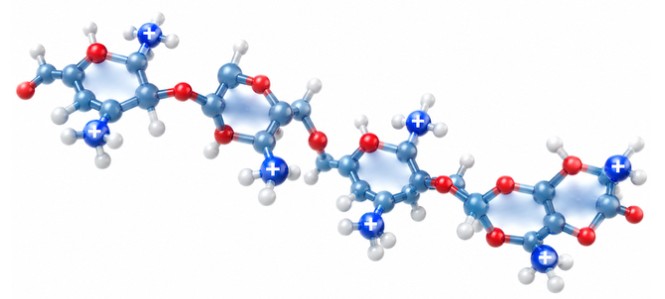
But the real advantage of chitosan is not simply its positive charge. It is the fact that these charges are distributed along a long polymer chain.
Why is being a polymer so important?
A polymer is a large molecule composed of numerous repeating units connected together. In chitosan, each unit can potentially carry a positive charge.
Unlike a small positively charged molecule that interacts with a single site, one chitosan polymer can establish multiple electrostatic interactions simultaneously with the same bacterial surface.
This phenomenon, called multivalent binding, creates a much stronger attachment than an individual electrostatic interaction.
Once attached, the polymer can interact with several negatively charged sites, disturbing the organization of the bacterial envelope. Depending on its molecular weight and structure, chitosan can also connect several bacterial cells together, promoting aggregation.
These interactions produce several biological effects:
- Disruption of bacterial membrane integrity and increased permeability.
- Leakage of intracellular components and interference with bacterial metabolism.
- Aggregation of bacterial cells, potentially facilitating their elimination.
- Reduced bacterial adhesion and biofilm formation under certain conditions.
Bacterial surfaces generally carry stronger negative charges than the outer membranes of intestinal epithelial cells (enterocytes), which contain predominantly neutral phospholipids and cholesterol.
Chitosan therefore preferentially interacts with bacterial surfaces, providing a degree of antibacterial selectivity.
Chitosan and organic acids: A catalytic-like synergy
Organic acids, particularly formic acid, are widely used to control bacterial proliferation in the digestive tract.
Their antibacterial activity depends partly on their ability to penetrate bacterial membranes in their undissociated form.
Once inside the bacterial cell, organic acids dissociate, releasing protons and anions. This disrupts intracellular pH regulation and forces bacteria to consume energy to restore their physiological balance.
Chitosan can reinforce this mechanism by acting first on the bacterial membrane.
Through multiple electrostatic interactions, chitosan destabilizes the bacterial envelope and increases membrane permeability. This may facilitate the action of organic acids and reinforce their intracellular antibacterial effects.
The combination therefore involves two complementary mechanisms:
- Chitosan binds to and destabilizes the bacterial membrane.
- Organic acids penetrate the bacteria and disrupt their internal metabolism.
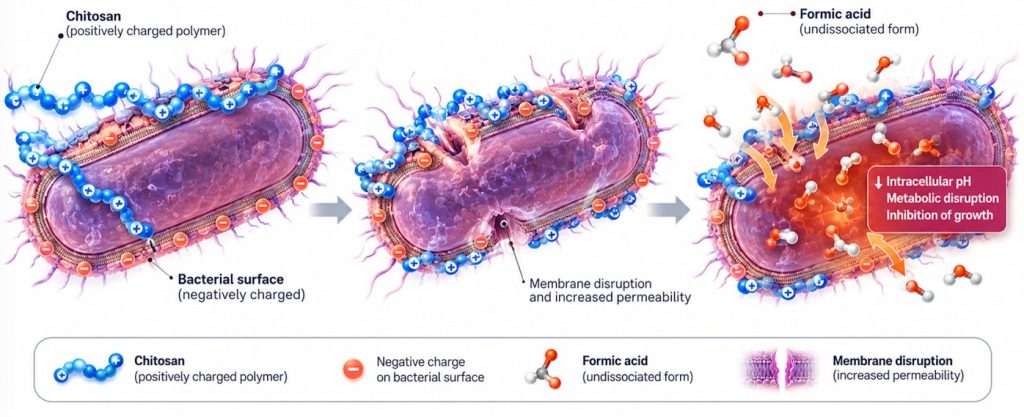
This complementary action can produce a catalytic-like effect, potentially reducing the minimum inhibitory concentration (MIC) of organic acids required to inhibit bacterial growth.
This potentiation may occur against both gram-negative bacteria, such as E. coli and Salmonella, and gram-positive bacteria, such as Clostridium perfringens.
Consequently, combining a relatively low dosage of chitosan with organic acids may achieve stronger antibacterial activity than either ingredient alone. It may also broaden the effective antibacterial spectrum against less susceptible strains.
A similar synergy may occur with zinc oxide, as chitosan-induced membrane destabilization could increase bacterial susceptibility to zinc ions. This association is particularly interesting for controlling pathogenic E. coli in post-weaning piglets.
Chitosan stands apart from conventional feed additives because its long polymer chains carry multiple positive charges capable of interacting simultaneously with bacterial surfaces.
Its greatest interest may therefore lie not in replacing existing antibacterial compounds, but in improving their efficiency at relatively low inclusion levels.
By weakening bacterial membranes, chitosan may enhance the action of organic acids and zinc oxide, potentially reducing the MIC required for effective bacterial control and offering nutritionists an additional tool for improving gut health.