

Swine and poultry are both monogastric species, yet their digestive systems function under distinct physiological constraints. These differences are not minor anatomical variations. They determine how nutrients are processed, how robust digestion is under stress, and how nutritional strategies must be designed. Understanding these divergences allows nutritionists to anticipate performance responses instead of interpreting them after problems arise.
Gastric Architecture
The gastric phase operates very differently in pigs and poultry, and this difference is central to digestive efficiency. In pigs, the stomach is a single glandular compartment where acid secretion, mixing and retention occur together. Feed remains in the stomach long enough for progressive acidification and controlled protein denaturation. Exposure time to low pH is relatively stable because gastric emptying is regulated and not primarily dependent on particle resistance. In this system, the duration of acid contact is fairly predictable. What varies most is the extent of pH reduction, which depends largely on the buffering capacity of the diet. High protein levels, mineral content or certain raw materials increase buffering and slow the decline in pH. Therefore, in pigs, gastric efficiency is mainly a question of how effectively the diet allows pH to drop rather than how long feed is exposed to acid
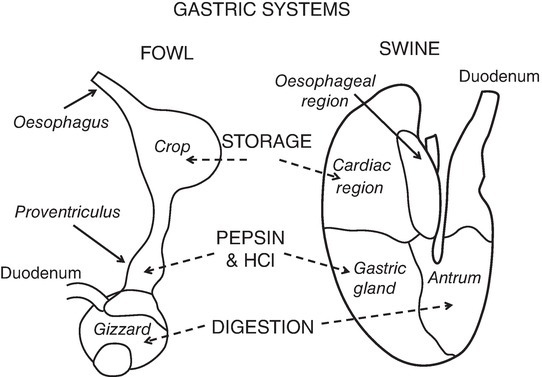
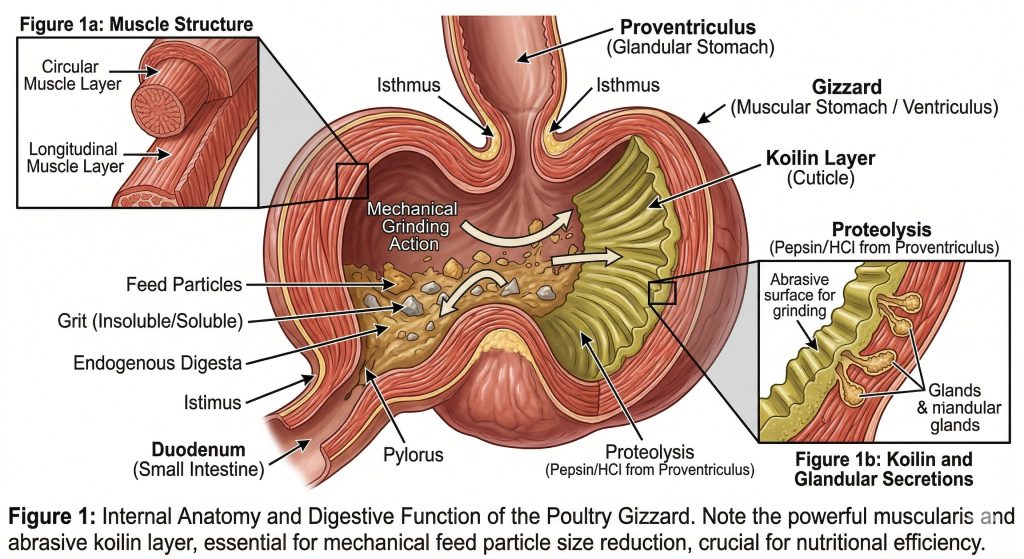
In poultry, acid is secreted in the proventriculus, but true exposure to acid takes place in the gizzard. The proventriculus produces hydrochloric acid and pepsinogen, yet feed passes through this compartment rapidly. It is in the gizzard that feed particles are retained, mixed with acidic secretions and subjected to mechanical grinding. The gizzard therefore determines how long feed remains in an acidic environment.
Retention time in the gizzard is not fixed. It depends strongly on particle size and on the muscular development of the gizzard itself. Coarse and resistant particles stimulate stronger contractions and prolong retention, allowing more extensive exposure to acid. Fine particles pass more rapidly into the small intestine. If the gizzard is underdeveloped due to insufficient structural stimulation, retention time decreases and feed may leave the acidic environment before complete protein denaturation occurs.
The contrast is clear. In pigs, exposure time to acid is relatively set, and the main variable is how much the pH drops, which is largely determined by dietary buffering capacity. In poultry, acid production may be adequate, but the decisive factor is retention. The efficacy of acidification depends on how long feed remains in the gizzard, which in turn depends on particle size and gizzard development. Gastric efficiency in pigs is primarily a chemical issue, whereas in poultry it is fundamentally a question of retention and mechanical regulation.
Mechanical Processing
The difference in gastric regulation extends into broader mechanical digestion.
Pigs begin mechanical digestion through mastication. Particle size reduction starts in the mouth, reducing the mechanical burden on the stomach. In pigs, fine grinding mainly influences surface area available for enzymatic digestion and fermentation kinetics. It does not determine organ development.
Poultry do not chew. The gizzard is the principal mechanical processor and its development depends directly on structural stimulation from the diet. When feed lacks sufficient resistance, the gizzard becomes less muscular, retention time decreases and digestive efficiency declines. Feed structure therefore affects digestive physiology at the organ level in poultry.
This distinction becomes particularly important when selecting structural fibers such as lignocellulose. In poultry, effective particle size in the gut should generally range between 300 and 800 microns, with an average around 600 microns, to properly stimulate gizzard development and maintain retention. Particles that are too fine lose structural impact and pass rapidly without supporting mechanical digestion. Excessively coarse or sharp particles may increase mucosal irritation instead of providing controlled stimulation. In pigs, because mastication already reduces particle size, the objective is different. Effective particle sizes around 200 to 300 microns for piglets and slightly higher for adult pigs are sufficient to regulate peristalsis and mucus turnover without excessive abrasion. The same fiber source therefore requires species specific granulometry to achieve the intended physiological effect.
Physiological Reflux
Digesta flow patterns further differentiate the two systems.
In pigs, movement is predominantly unidirectional. Feed progresses from stomach to small intestine and then to colon. Segmentation contractions allow mixing within compartments, but there is minimal true retrograde movement between major digestive sections. Once feed leaves a compartment, it is rarely reprocessed in that same location. Digestion therefore depends heavily on first pass efficiency within each segment.
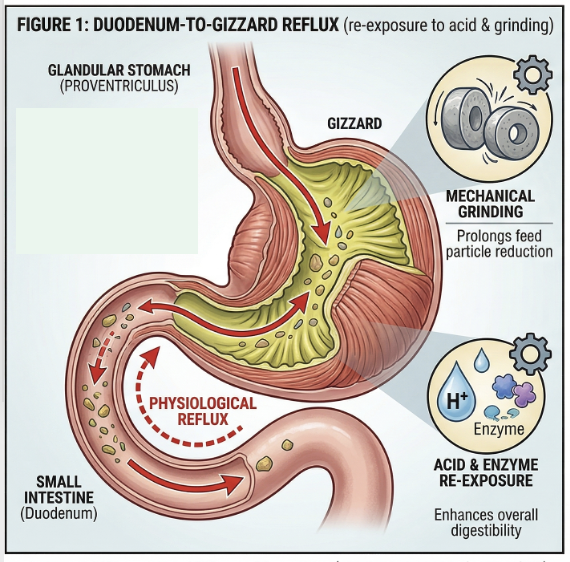
In poultry, digestion includes structured reflux mechanisms. Material can move from the duodenum back to the gizzard, allowing feed particles to be re exposed to acid and mechanical grinding. There is also bidirectional movement between ileum and ceca, prolonging microbial interaction. These reflux loops are part of normal physiology and contribute to processing efficiency.
This difference has important implications for enzyme activity. In poultry, exogenous enzymes may benefit from repeated exposure to their substrates because reflux allows partial reprocessing of feed particles. The same substrate can encounter enzymatic activity more than once before progressing distally. In pigs, enzyme action depends more strictly on forward transit and effective mixing during the initial passage through the small intestine. If hydrolysis is incomplete during this first exposure, the opportunity for correction is limited. Flow directionality therefore influences how forgiving the system is to variations in enzyme efficiency or substrate accessibility.
Transit Speed
Poultry have a relatively short intestinal tract and rapid transit time. Growth rates are high and nutrient absorption must occur efficiently within a limited time window. The physiological margin for inefficiency is narrow. Small disturbances in digesta characteristics can rapidly translate into measurable performance differences.
One of the most critical disturbances is increased viscosity caused by soluble non starch polysaccharides. Poultry are more sensitive to higher viscosity than pigs. When soluble fibers increase water binding and form gel like structures in the intestinal lumen, diffusion of enzymes and nutrients is impaired. Nutrient absorption declines, microbial imbalance may increase, and litter quality can deteriorate.
Pigs possess a longer small intestine and slower passage rate, providing more opportunity to compensate for moderate increases in viscosity. While excessive soluble fiber can still impair performance, the system is generally more tolerant.
For this reason, reducing soluble fiber content is particularly important in poultry diets. Controlling inclusion of ingredients rich in soluble NSP and using strategies to limit viscosity are central elements of broiler nutrition. In pigs, management of soluble fiber remains relevant but is typically less critical than in poultry because the longer digestive tract provides greater absorptive margin.
Hindgut Fermentation Capacity
The pig colon is large and metabolically active. Fermentation of residual carbohydrates produces short chain fatty acids such as acetate, propionate and butyrate. These metabolites provide energy to colonocytes, support epithelial integrity and influence systemic metabolism. Hindgut fermentation contributes meaningfully to maintenance energy and mucosal health in pigs.
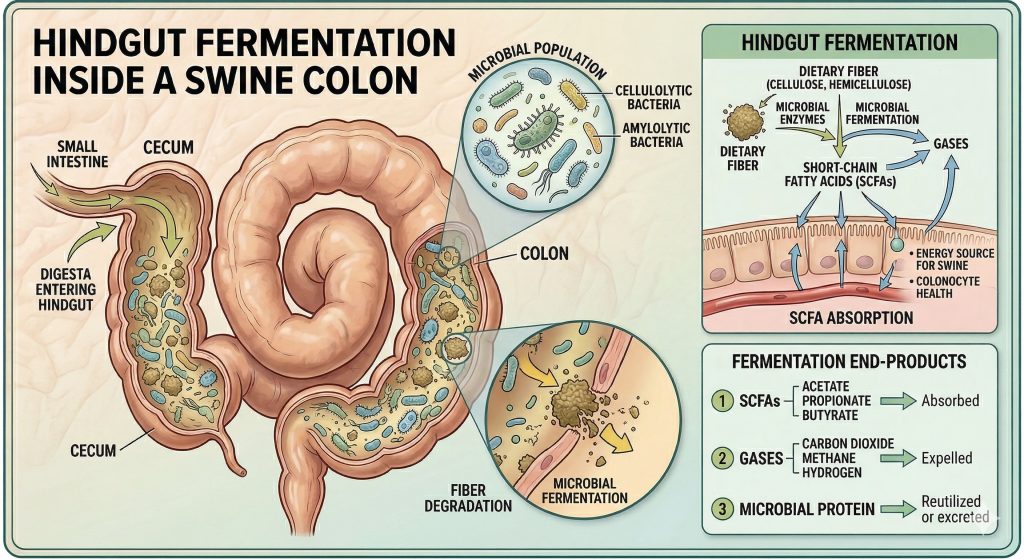
Poultry possess paired ceca with active microbial populations, but the energetic contribution of fermentation is limited. Most nutrient absorption must occur before the ileum. Material reaching the ceca undergoes microbial metabolism, yet the system is less capable of recovering substantial energetic value from undigested substrates.
This difference explains why butyric acid or probiotic strategies may produce distinct outcomes. In pigs, delivering butyrate or stimulating endogenous production supports a metabolically significant organ and can influence both epithelial health and overall energy balance. In poultry, the primary effect is stabilization of barrier function and microbial equilibrium rather than meaningful energy recovery.
Taken together, these physiological divergences reveal a fundamental contrast. The pig digestive system is chemically progressive, fermentation supported and relatively forgiving. The poultry digestive system is mechanically dependent, reflux regulated and highly sensitive to viscosity, operating with greater physiological precision. Recognizing these distinctions enables nutritionists to design species specific nutritional strategies that align with digestive architecture rather than assuming that all monogastric systems function in the same way.
David Serene
Nutrispices Director