
News
Please stay connected with us. Each month, we publish a Nutricles, an article featuring industry trends, news updates, and sustainability insights related to the animal feed industry. We hope these articles provide you with valuable and relevant information.

In piglet nutrition, zinc oxide has long been a trusted ally. For decades, nutritionists have relied on it to fight post-weaning diarrhea, boost gut health, and help young pigs thrive through their most fragile weeks. Yet behind this familiar white, black or yellow powder lies a deeper truth: not all zinc oxide is created equal. While many feed formulators focus on the dosage, how many kilograms per ton, how many weeks in the program, the real story, and often the real problem, comes down to something less obvious: the physical and chemical nature of the zinc oxide itself. The analysis of multiple zinc oxide sources used across Asia and beyond has enabled to identify three distinct families of products, illustrated by different color and each behaving differently in the piglet’s digestive tract and each with its own consequences for antibacterial efficacy. Family One: White, Fast, and Short-Lived The first family of zinc oxide products is typically white in color and comes mostly from Asian sources. These products have small particle size, low density, but relatively high surface area. At first, they look like strong performers. The high surface area suggests plenty of material ready to interact with bacteria, giving a sharp antibacterial punch, on paper at least. But once these small, light particles hit the piglet’s stomach acid, they dissolve rapidly, sometimes too rapidly. The zinc ions release so quickly that by the time they meet bacteria, the antibacterial effect has already faded away. To compensate, nutritionists often increase the dosage, usually pushing up to 3 kilograms per ton of feed. But this raises serious concerns: Toxicity risks, especially if used for more than two weeks Reduction of feed intake as zinc taste is rejected by piglets Blocking actions of phytases Environmental burdens due to zinc excretion Regulatory red flags

Sulfur is an essential element in animal nutrition, present in many feed ingredients and additives. It is a key component of amino acids like methionine and cysteine and is necessary for protein synthesis and metabolic functions. However, excessive sulfur intake, whether from organic or inorganic sources, can cause significant toxicity issues in both swine and poultry. In animal feeding practices, several key contributors to sulfur intake consistently stand out: DDGS, lysine sulfate, copper sulfate and high-sulfur protein meals such as canola and soybean meals can increase the total sulfur load. Canola meal, soybean meal, and other protein-rich by-products contain significant amounts of organic sulfur, primarily in the form of sulfur-containing amino acids like methionine and cysteine. Canola meal, for instance, contains around 0.6-0.8% total sulfur. Although this sulfur is organic rather than inorganic sulfate, excessive inclusion of these meals can still increase the overall sulfur load in the diet. DDGS, a by-product of ethanol production, contains around 0.5-1% total sulfur, which includes both organic sulfur from protein content and inorganic sulfate. The sulfur content in DDGS primarily originates from the use of sulfuric acid during the ethanol production process to control pH and clean equipment. Due to its high protein and energy content, DDGS is commonly included at rates of 5-10% in animal diets contributing approximately 50 to 100 grams of sulfur per ton of feed. Lysine Sulfate Lysine sulfate, used as a cost-effective lysine source, contains 20-25% sulfate. In typical diets, lysine sulfate is included at 0.5-1%. Since sulfate itself contains about 33% sulfur, we can expect approximately 330-825 grams of sulfur per ton of feed, making lysine sulfate one of the main sources of sulfur, particularly in swine and poultry rations. Copper Sulfate Copper sulfate (CuSO₄·5H₂O) contains about 40% sulfate. When copper sulfate is used as a growth
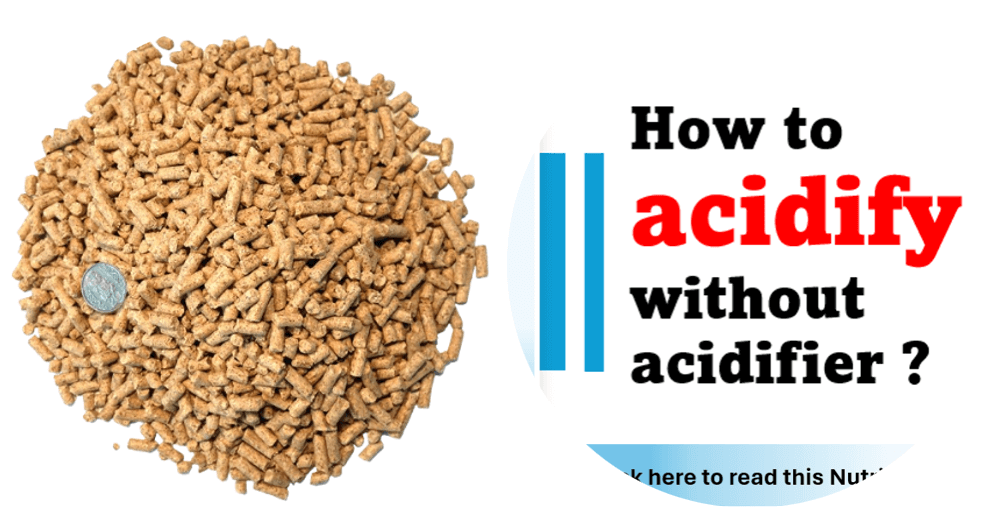
The acidification of the stomach serves as the first natural line of defense against bacterial contamination in the gut. This function is particularly crucial for piglets and chicks, as their ability to produce gastric acids is limited in early life. A well-acidified stomach not only helps with digestion through activaction of pepsinogen enzyme and solubilisation of minerals but also prevents pathogenic bacteria from reaching the intestines, reducing the risk of infections and improving overall gut health. To support this process, various organic and inorganic acids are commonly incorporated into animal feed. Formic acid, propionic acid, citric acid, fumaric acid, and lactic acid are among the most widely used acidifiers. These acids effectively lower the pH in the stomach, creating an environment that inhibits harmful bacteria while enhancing nutrient absorption. However, their application is not without challenges. When used at inclusion rates of 10 to 15 kg per ton of feed, these acids often exhibit strong odors and corrosive properties, making handling and storage difficult for feed manufacturers.In certain situations, such as when formulating premixes, manufacturers seek non-corrosive alternatives to achieve stomach acidification. This need has led to the adoption of an indirect acidification strategy, which focuses on lowering the Acid Binding Capacity (ABC) of the diet rather than directly introducing acids. By reducing the ABC of feed, it becomes easier for the piglet or chick’s natural gastric acid secretion to maintain an optimal pH, without the drawbacks associated with traditional acidifiers. The Role of Acid Binding Capacity in Feed AcidificationAcid Binding Capacity (ABC) measures the buffering effect of a diet—essentially, the amount of acid required to lower its pH to a target level. Ingredients with high ABC values require more acid to achieve the same pH reduction, placing a greater burden on the animal’s digestive system and necessitating higher levels

As the global demand for sustainable and natural agricultural practices intensifies, the use of plants in animal nutrition is emerging as a promising solution to reduce reliance on synthetic additives. Plants serve numerous purposes in animal nutrition. The polyphenols and their role as antioxidants is already well know. Grape seed extract and trans-anethole reduce oxidative stress and enhance antioxidant capacity, supporting overall health. To modulate the immune system, Astragalus roots stimulates immune function and resilience, while Echinacea boosts the immune response against pathogens. Gut health can also be significantly improved through garlic, which balances gut microbiota, and oregano, which provides antimicrobial properties to enhance gut integrity. In aquaculture, plants provide specific benefits, such as spirulina, which enhances pigmentation and immune function, and kelp, which supplies essential minerals and polysaccharides for stress resilience and growth. But in this month Nutricle, I would like to have a specific approach on the plants recommended for promoting feed intake and growth performance. For Piglets, Broilers, and Fish Fenugreek stimulates appetite through bioactive compounds like saponins and alkaloids, enhancing feed palatability and promoting digestive enzyme secretion. Curcuma acts as an anti-inflammatory and antioxidant, promoting better feed utilization and growth. Ginger improves gut health and enhances enzymatic activity, boosting growth rates. For Sows and Layers Fenugreek stimulates appetite and supports lactation by promoting milk yield and improving nutrient availability, making it particularly valuable for enhancing sow productivity. Maca enhances reproductive performance and hormonal balance, improving recovery post-farrowing and supporting egg production in layers. Ginseng strengthens metabolic energy and immunity, contributing to productivity and resilience. For Shrimps Curcuma acts as an antimicrobial and antioxidant, reducing disease incidence and improving feed efficiency. Fenugreek, due to its high saponin content, helps reduce toxic ammonia levels while enhancing appetite and digestive efficiency. Similarly, Yucca, also rich in saponins, improves water

Current livestock farming practices differ significantly from natural conditions, affecting how piglets and chicks develop and adapt to their environments. In nature, piglets remain with their mothers and nurse for extended periods before gradually transitioning to solid feed, allowing their digestive systems to mature slowly. Similarly, chicks benefit from a prolonged relationship with their mother, picking up beneficial bacteria from her feathers, droppings, and the environment she introduces them to, which helps establish a healthy gut microbiota. A balanced microbiota plays a crucial role in nutrient digestion and pathogen defense, strengthening the chicks’ immune systems and supporting digestive health. However, modern farming necessitates weaning and feeding animals earlier than in natural settings, often before their digestive systems are fully prepared to handle solid food. This early weaning can challenge the digestive health of both piglets and chicks. Unlike their wild counterparts, farm animals face solid feed and environmental exposure to pathogens at a time when their stomachs and intestines are still underdeveloped. The lack of a gradual transition to solid food can stress their digestive systems, affecting their ability to process nutrients efficiently, which has implications for their growth and health. One of nature’s primary defense mechanisms against pathogens is the acidification of the stomach. This natural process creates a hostile environment for harmful bacteria, limiting their growth and reducing the risk of infections. Stomach acidity plays a vital role in killing or reducing bacteria before they can enter further into the digestive tract. However, when weaning occurs prematurely, the immature digestive systems in piglets and chicks may not yet produce adequate levels of stomach acid, increasing their vulnerability to bacterial overgrowth and associated health risks. Research Insights on Digestive Challenges During Weaning Recent research highlights the unique challenges faced by piglets during weaning. In a study led by Henza

This month, I would like to share an interesting tool aiming at monitoring formulation performance. We are touching a very critical topic that dictates the competitive game between feed millers. It is about which company will formulate the best feed at the cheapest cost. It requires a lot of intelligence, time and energy to build set of feed formulas and we need to be sure that not only they are performing better than the competition but that we are actually getting better every month. I am sure that you will be interested in the following article. The job of nutritionist changed a lot in the past years. Nutritionist does not prepare formulas anymore. They are responsible for defining the constraints that will enable optimization software to select the cheapest option. The formulation perimeter is the space allowed to the software between 4 distinct sets of constraints; nutritional requirement, non-nutritional requirement, raw material composition and raw material prices. The mission of nutritionist is to adjust this formulation perimeter (by increasing or decreasing the constraints) to optimize the feed performance (FCR, feed cost, growth, mortality, feed intake, etc…). The difficulty of this process lies in the fact that raw material prices are constantly changing, thus, obliging the software to modify the formulas. Therefore, we cannot compare the performance of formulas made with today’s prices with the ones made yesterday. The economical context varies and makes internal benchmarks difficult over time. FORMULATION PERFORMANCE INDEX The tool that we propose is called FPI for Formulation Performance Index. It is used to monitor the improvement of the formulation skills during a period of time. During the year, formulation will change due to: As we are trying to evaluate if the changes of the perimeter done by the formulator are having a positive impact on the


